


Written by
Dr. Jessica Maxwell
Relationship Expert
Jessica is Cupla’s in-house relationship expert and an Assistant Professor of Social Psychology at McMaster University, with a Ph.D. from the University of Toronto. She studies what keeps couples close, and her research on romantic relationships has been featured by the BBC, Radio NZ, and Psychology Today.
 LinkedIn
 As Covid restrictions slowly lessen, and we look to resume more of a normal pace, it is time to take stock of the relationship effects Covid has left in its wake.
Some couples are re-emerging from the pandemic fragile and battered from the storm, whereas others are doing better than ever. Understanding which couples struggled vs. thrived during the pandemic provides key insights to implement for healthy relationships long after Covid (hopefully) becomes a faded memory.
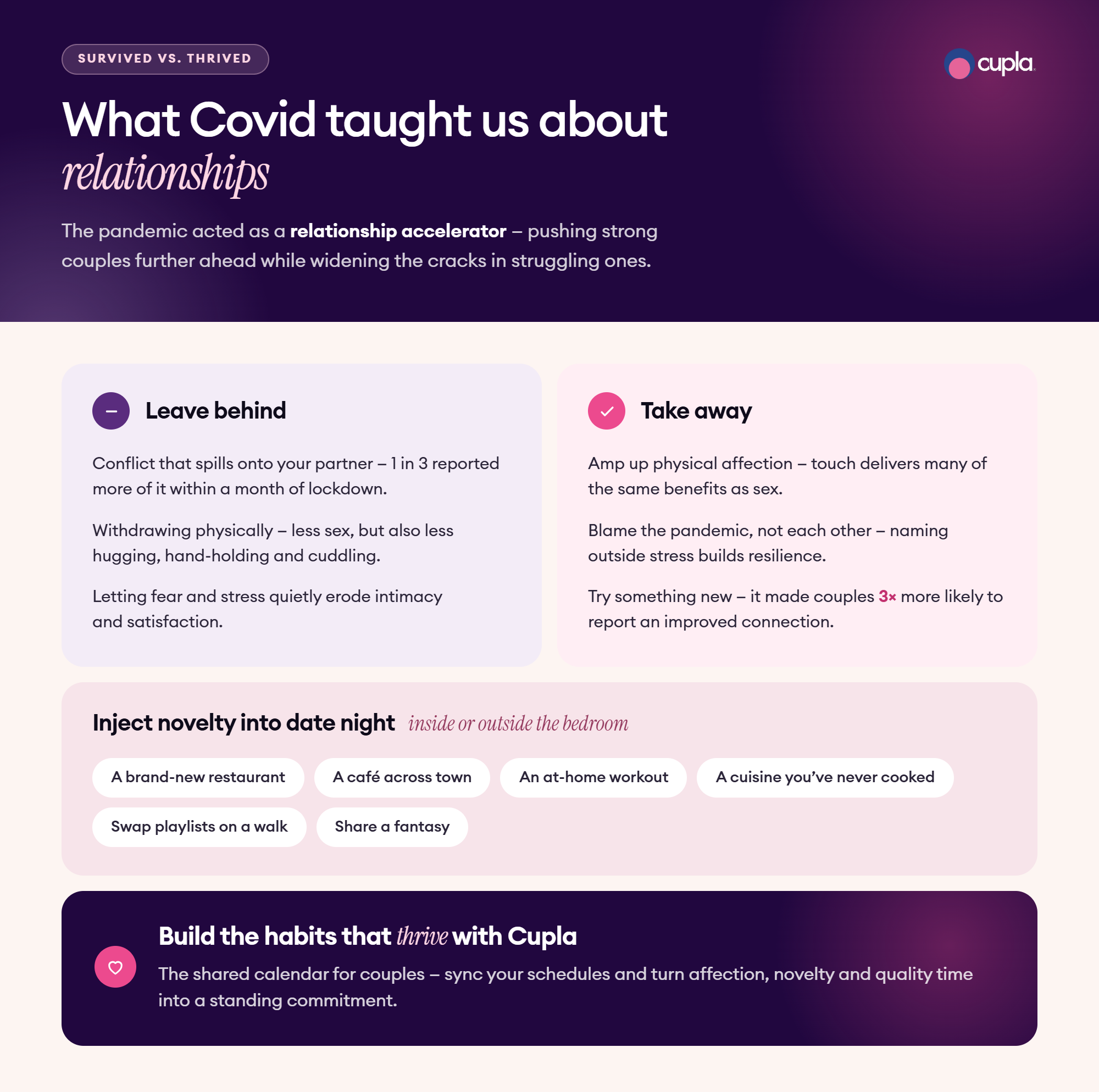
Covid-19, much like other natural disasters, may simultaneously result in more happy marriages, babies, AND more divorces. Yes, you read that right. This seeming contradiction is clarified by couple’s therapist, and best-selling author Esther Perel who uses the analogy of Covid as a relationship accelerator: pushing those in good relationships further down the path to success, while exacerbating cracks in struggling relationships.
This idea of Covid as an “accelerator” echoes research on couples’ relationships during the pandemic, including research conducted in New Zealand. Covid has magnified the pre-existing insecurities and cracks we had in our relationships, and given both our adaptive and perhaps less adaptive coping strategies (ahem, downing a bottle of chardonnay perhaps) the chance to shine.
Given Covid amplified the best and the worst of relationships, let’s take a deeper look into what couples should leave behind vs. takeaway from the pandemic.
Relationship Habits to Leave Behind After Covid
If you and your partner struggled during Covid, you are not alone. Healthy relationship or not, even just one month into the pandemic, a third of Americans sampled reported greater conflict with their partner directly as a result of Covid and its restrictions. In New Zealand, divorce lawyers are reporting increased demand.
People’s sex lives experienced a similar blow. In one study (again out of the U.S.), nearly half of the participants reported declines in their sex life since the pandemic. And those who were experiencing more relationship conflict were the worst hit. People reporting more conflict with their partner not only had less sex, but also engaged in less physical affection across the board, including less hugging, hand-holding and cuddling. This is unfortunate because not only were these couples missing out on relationship and health benefits of sex, but the benefits of physical touch as well.
Others did engage in sex with their partner, but let their fear of contracting Covid detract from their satisfaction. If you relate to these findings and your sex life fell by the wayside during the pandemic, I suggest easing back into things by trying to increase your physical affection, which offers many of the benefits of sex.
Despite these challenges that Covid posed, there’s a lot we can learn from relationships that thrived during this time.
Covid Lessons for a Healthy Relationship
It’s Covid’s fault. Did lockdown cause you and your partner to fight more than ever before? Is your stress at an all-time high, and no amount of baths or binging reality tv can make it go away? Blame the pandemic! It may sound obvious but don’t underestimate the role Covid “and not you or your partner” may have played in your current stress and problems.
Women who attributed their stress to the pandemic were more resilient to stress throughout the pandemic. Being able to appreciate that their current stress was likely Covid’s fault, and not theirs or their partner’s helped these women stay more satisfied with their relationship even on days when they felt a lot of stress (e.g., with chores, finances etc.). In other words, if you and your partner weren’t exactly #couplegoals in the last few years don’t beat yourself up: remember the global health crisis likely played a huge part in your stress.
Spice Things Up – In and Out of the Bedroom
Despite Covid causing many couples to have a sexual slump, in one study, about 20% of surveyed Americans reported their sex life actually improved from pre-pandemic! In fact, one factor made couples 3x more likely to report improvement. The secret? Adding something new to their sexual repertoire. Popular reported additions were sexting and sharing a sexual fantasy with a partner (great ways to keep things spicy during social distancing!), and trying a new sex position.
But what if you and your partner weren’t exactly expanding your sexual horizons during the pandemic? It is not too late to incorporate these ideas! Trying something new with your partner like the examples above, can bring you closer together and reignite your passion. In fact, you can inject your next date night with novelty in a variety of ways outside the bedroom:
- Try out a new restaurant you found online
- Head to a coffee shop in a different part of town
- Attempt a new at-home workout together
- Cook a cuisine neither of you has tried before
- Swap playlists and go for a walk with each other’s favorite music
These healthy relationship ideas will maximize your quality time with your partner by helping you connect, learn more about them, and see them in a new light: all key ingredients for keeping your spark going strong.
So what have we learned from couples’ experiences during the pandemic that can be used going forward?
- Amp up your physical affection
- Appreciate the role Covid may have played in your problems
- Try something new (inside or outside the bedroom) on your next date night
FAQ: Healthy Relationships
What is a healthy relationship?
Healthy relationships are built on connection, not perfection. Couples who thrive share regular physical affection, keep learning about each other, and don’t blame themselves or their partner for external stress. Even happy couples face conflict – what matters is how you handle challenges together.
How to have a healthy relationship?
Amp up physical affection like hugging, hand-holding, and cuddling as touch offers real relationship and health benefits. When stress hits, recognize outside factors (like a global pandemic!) instead of blaming your partner. This resilience helps couples stay satisfied even on high-stress days.
How to maintain a healthy relationship?
Novelty is key: couples who tried something new were three times more likely to report an improved connection. Keep things fresh in and out of the bedroom: visit a new restaurant, cook an unfamiliar cuisine, swap playlists, or share a fantasy with your partner.
Build Your Healthy Relationship Habits with Cupla
If the pandemic taught us anything, it’s that healthy relationships don’t happen by accident: the couples who thrived were the ones who made time for affection, novelty, and each other, even when life got chaotic. That’s exactly what Cupla is built for. As a shared calendar designed for couples, Cupla helps you sync your schedules, plan those novelty-filled date nights, and turn quality time from a nice idea into a standing commitment. Whatever the next few years throw at you, you’ll be one of the couples who comes out stronger. Download Cupla today and start building the habits that keep your spark going strong.