



Erika Palmer
Co-Founder of CuplaErika started Cupla with her husband Will after realising how easily date night slips when two busy lives collide. Today she leads the company’s mission to give couples back their quality time — and still swears by a long nature walk and a table at a restaurant neither of them has tried before.
 LinkedIn
Between work, chores, kids’ schedules, and the endless scroll, it can feel impossible to figure out how to make time for your partner. If your relationship has started to feel more like a logistics operation than a love story, you’re not alone – and the fix is more achievable than you might think.
Research shows couples who intentionally carve out time for each other, no matter how small, report higher relationship satisfaction and lower stress levels (Impett et al., 2020). The key insight? Quality time doesn’t magically appear in busy lives. It gets planned in.
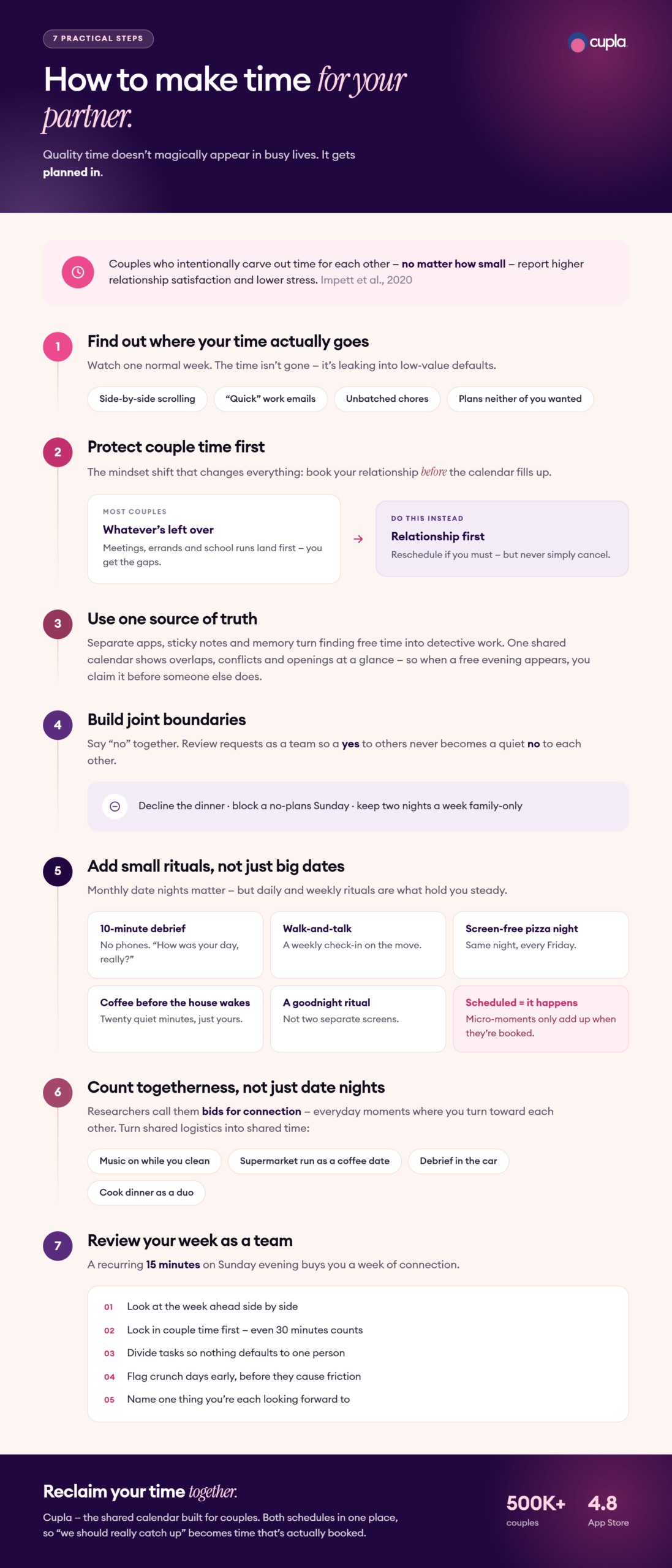
In this guide, we’ll walk through seven practical steps to make more time for your partner, no matter how packed your calendar looks:
- Find out where your time actually goes
- Protect couple time first
- Use one source of truth for your schedules
- Build joint boundaries
- Add small rituals, not just big dates
- Count togetherness, not just date nights
- Review your week as a team
Why Making Time for Your Partner Matters
When life gets hectic, quality couple time is usually the first thing to vanish. Many partners end up operating like coworkers managing a household rather than lovers enjoying each other. The problem isn’t a lack of love: it’s a lack of structure.
Time together is the raw material of a relationship. It’s where inside jokes form, where small worries get aired before they become big resentments, and where you remember why you chose each other in the first place. Couples who stop making time don’t stop loving each other overnight – they slowly drift into parallel lives. The good news: the drift works in reverse, too. Even modest, consistent investments of time rebuild connection surprisingly fast.
How to Make Time for Your Partner: 7 Practical Steps
Step 1: Find Out Where Your Time Actually Goes
Before you can make more time for your partner, you need to know where your time is disappearing. For one normal week, pay attention to your evenings and weekends. Most couples discover the time isn’t truly gone, it’s leaking into low-value defaults:
- Scrolling side by side without actually talking
- “Quick” work emails that swallow a whole evening
- Chores that could be batched, shared, or scheduled
- Social commitments neither of you actually wanted
You don’t need to eliminate all of these, just spot the one or two hours a week you can reclaim for each other.
Step 2: Protect “Couple Time” First
Here’s the mindset shift that changes everything: schedule your relationship before everything else, not after. Before filling your shared calendar with meetings, errands, and school runs, block out time for each other. It doesn’t need to be elaborate – a standing Wednesday night micro-date or even a morning coffee ritual counts.
When couple time is locked in early, everything else organizes around your relationship, not over it. Treat these blocks like you’d treat an important meeting: reschedule if you absolutely must, but never simply cancel.
Step 3: Use One Source of Truth
Text messages and fragmented reminders are where most couples stumble. When your schedules live in separate apps, sticky notes, and memory, finding shared free time means playing detective. A shared calendar app like Cupla shows both schedules side by side, making it clear where overlaps, conflicts, and openings are. You see the full picture, without another 27 back-and-forth texts.
Bonus: when a free evening opens up, you’ll actually see it and can claim it for each other, instead of letting it get eaten by whoever asks first.
Step 4: Build Joint Boundaries
One underrated move? Saying “no” together. Too often, one partner commits the couple without checking in, and suddenly the last free weekend of the month is gone. Instead, review requests as a team and agree on your boundaries, whether that’s declining a dinner, blocking a no-plans Sunday, or keeping two nights each week family-only.
Boundaries aren’t about becoming hermits, they’re about making sure the “yes” you give to others doesn’t quietly become a “no” to each other.
Step 5: Add Small Rituals, Not Just Big Dates
Yes, a monthly date night matters, but daily and weekly rituals are what hold you steady. Try:
- Ten-minute debriefs after work: no phones, just “how was your day, really?”
- Friday pizza night with no screens
- Weekly walk-and-talk check-ins
- A shared coffee before the household wakes up
- A goodnight ritual that doesn’t involve falling asleep to separate screens
These micro-moments add up – and when they’re scheduled, they actually happen. If you want the science behind why rituals matter so much, read our guide on the hidden cost of skipping couple rituals.
Step 6: Count Togetherness, Not Just Date Nights
Not every moment together needs to be a capital-D Date. Folding laundry while catching up, cooking dinner as a duo, or running errands together all count as connection when you’re actually present for them. Relationship researchers call these “bids for connection”: small everyday moments where you turn toward each other instead of away.
The trick is turning shared logistics into shared moments: put on music while you clean, make the supermarket run a coffee date, debrief in the car. If your weeks are genuinely full, this is where the extra couple time hides.
Step 7: Review Your Week as a Team
Making time for your partner isn’t a one-time fix, it’s a weekly habit. Set a recurring 15-minute planning session (Sunday evening works well for most couples) and run through it together:
- Look at the week ahead side by side in your shared calendar
- Lock in your couple time first, even 30 minutes counts
- Divide the week’s tasks and chores so nothing falls on one person by default
- Flag any conflicts or crunch days early, before they cause friction
- Agree on one thing you’re each looking forward to together
Fifteen minutes of planning buys you a week of connection and spares you a week of “wait, you booked what?”
FAQ: How to Make Time for Your Partner
How do I make more time for my partner?
Schedule couple time first, before other commitments fill your calendar. Track where your evenings actually go, reclaim one or two low-value hours each week, and protect small daily rituals like after-work debriefs. Couples who plan time together report higher relationship satisfaction than those who leave it to chance.
How do I make time for my partner with a baby?
Lower the bar and raise the frequency. Swap date nights for nap-time coffees, couch picnics after bedtime, and ten-minute daily check-ins. Sync schedules in a shared calendar so free pockets are visible, and trade solo-parenting shifts so each of you gets rest – a recharged partner is a more present one.
How do you make time for each other when your schedules don’t match?
Focus on overlap, not availability. Put both schedules in one shared calendar to spot the windows you do share, even 20 minutes at breakfast counts. Build rituals around your fixed overlap points, leave notes or voice messages for the gaps, and protect your rare mutual days off fiercely.
The Bottom Line: Make Time for Your Partner, On Purpose
A busy life doesn’t have to mean a disconnected relationship. Learning how to make time for your partner comes down to three habits: put your relationship in the calendar first, keep both schedules in one place, and protect small rituals as fiercely as big plans. None of it requires more hours in the day, just a decision about where the hours you have should go.
Ready to reclaim your time together? Download Cupla and turn “we should really catch up” into time that’s actually on the calendar.


