


Fred spends his days figuring out how people discover Cupla and turning that into growth. Off the clock, he’s usually making music, building his fantasy world Mythanien, gaming, or plotting another trip between Germany and New Zealand, ideally with a cold non-alcoholic beer nearby.

When my wife and I started planning our wedding in 2013, we hit a problem nobody had warned us about. We were the first couple in our whole circle of friends and family to get married in almost 20 years.
Nobody to ask. Nobody who’d done it recently. And the wedding guides online back then were pretty bad, to put it kindly.
So we learned it the hard way: how to manage the time, the money and the people, and how to balance it all out between the two of us. Consider this article my personal mission: to give you the checklist we didn’t have back then.
What’s on a wedding planning checklist?
Here’s the short answer to how to plan a wedding. A wedding planning checklist runs from the week after you get engaged to the week after the wedding. Agree on your budget, guest count and rough date first. Book the venue and the people who book up earliest about a year out.
Then work through outfits, invitations, final numbers and the day itself in order. The average engagement in the US lasts 15 months, according to The Knot’s 2025 Real Weddings Study, so the timeline below assumes about a year of planning and shows you what to squeeze if you have less.
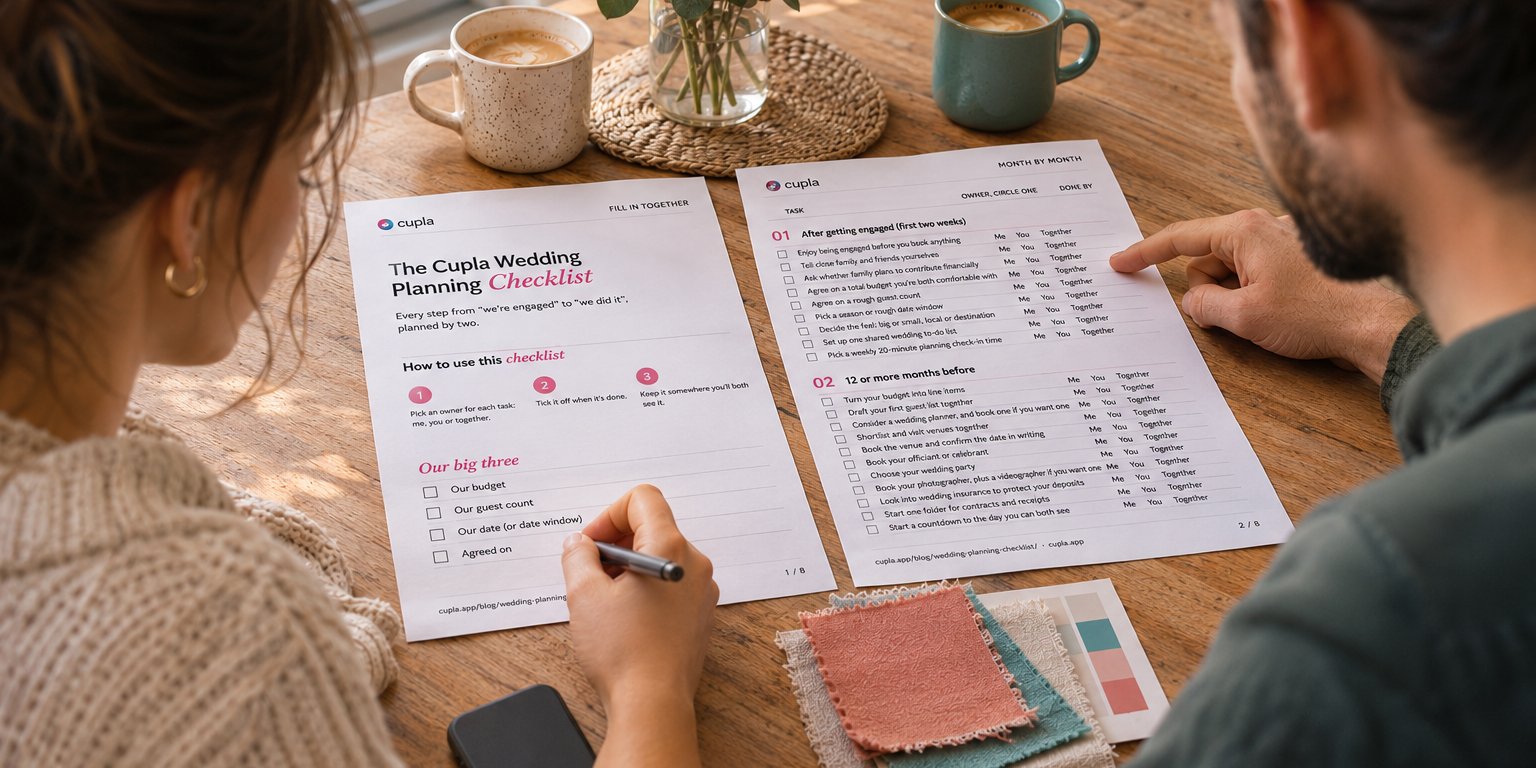
Most checklists are written for one person doing the planning. This one is written for two. Every task can have an owner (me, you or together), and the free printable at the end has a column for exactly that. We also show how we’d run the whole thing in Cupla, but the checklist works fine on paper.
Your wedding planning timeline checklist at a glance
| When | Focus |
|---|---|
| After getting engaged (first two weeks) | Celebrate, tell people, agree on the big three: budget, guest count, rough date |
| 12 or more months before | Budget, guest list, venue, officiant, photographer |
| 9 to 11 months before | Caterer, music, florist, outfits, guest rooms |
| 6 to 8 months before | Save-the-dates, registry, hair and makeup, honeymoon |
| 4 to 5 months before | Final guest list, invitations, menu, wedding bands, marriage license rules |
| 2 to 3 months before | Send invitations, vows, confirm vendors, trials |
| The final month | RSVPs, final numbers, seating plan, day-of timeline |
| The final week | Confirm arrival times, pack, rehearse, rest |
| The wedding day | Eat, hand over the jobs, sign the paperwork, enjoy it |
| The week after | Returns, paperwork, thank-you notes |
What should you do after getting engaged?
For the first two weeks, do almost nothing. Enjoy it. Tell the people who matter before they see it online, and resist the urge to book a venue on day three because a friend said they fill up fast.
The one job that matters in this stretch is agreeing on the big three: budget, guest count and a rough date. Every later decision depends on them. A venue for 60 and a venue for 200 are different searches, and a peak-season Saturday costs more than an off-season Friday. Get these three settled between you first, and the rest of the checklist gets a lot simpler.
If money talk feels awkward, it doesn’t have to be one big sit-down. Our guide to money questions to ask as a couple has a gentle way in.
Engagement checklist: the first two weeks
| To-do | Why now |
|---|---|
| Enjoy being engaged before you book anything | Early bookings made in a rush are the ones couples regret. |
| Tell close family and friends yourselves | It’s kinder than them finding out from a post. |
| Ask whether family plans to contribute financially | You can’t set a real budget without knowing this. |
| Agree on a total budget you’re both comfortable with | It decides venue, guest count and almost everything else. |
| Agree on a rough guest count | Venues are shortlisted by capacity first. |
| Pick a season or rough date window | You’ll need it the moment you call a venue. |
| Decide the feel: big or small, local or destination | It changes which checklist items apply to you. |
| Set up one shared wedding to-do list | One list beats two half-lists and a dozen texts. |
| Pick a weekly 20-minute planning check-in time | Keeps wedding talk out of every other evening. |
How do you split wedding planning between two people?
Give every task one owner, keep one shared list, and meet for 20 minutes once a week. That’s the whole system.
It sounds simple because it is. What it changes is the pattern where one of you becomes the default planner, holding every vendor email and deadline in their head, while the other asks “what can I do?” and waits to be told. That’s the mental load at work, and a wedding just turns up the volume. Fairness matters more than you’d think: in Cupla’s 2025 Impact Report, a survey of 2,110 users, 59% said Cupla increased fairness in their relationship.
Here’s how to set it up.
Split by ownership, not by effort. Go through the checklist together and mark each task Me, You or Together. The owner doesn’t have to do all the work. They make sure it gets done, chase the vendor, and bring options to the check-in. Pick by interest first (the one who cares about food owns the caterer), then balance the load.
Keep big decisions joint. Venue, budget, guest list and officiant are Together tasks for almost every couple. Everything else can usually be owned by one of you, with the other getting a veto.
Hold a weekly 20-minute check-in. Same time each week. Each owner says what moved, what’s stuck and what needs a joint decision. Then stop. The rest of the week is not for wedding talk, which is the real benefit.
Write it all in one place. Not one of your notes apps, not a group chat, not a spreadsheet only one of you can find. One list you can both see and both tick off.
How we’d set this up in Cupla
This is exactly the kind of planning Cupla is built for. Here’s how we’d run a wedding in it.
- A Wedding to-do list. Copy the checklist below into a shared to-do list, one task per item. Set who’s responsible for each task and give it a due date, so you both see what’s yours and what’s coming up.
- Every appointment on the calendar. Venue visits, tastings, fittings and the marriage license appointment go on the calendar, where you can see them next to each other’s schedules. Link the to-do to the event, so the details travel with it.
- A countdown you both see. Add your wedding day as a Key Date and switch on its countdown. Our countdown widget guide shows how to put it on your home screen.
As one couple put it in our 2025 Impact Report: “Having a shared space to plan, track, and reflect on our relationship has made us feel like a stronger team.”
What should you do 12 or more months before the wedding?
Book the venue and the people who book up earliest: officiant, photographer and, if you want one, a planner. Your date isn’t real until the venue confirms it in writing, so that’s the first booking and everything else follows it.
| To-do | Why now |
|---|---|
| Turn your budget into line items | Shows what’s left for each vendor before you fall for one. |
| Draft your first guest list together | Two separate lists merged later always means cuts. |
| Consider a wedding planner, and book one if you want one | Good planners book out early, and they can find your venue. |
| Shortlist and visit venues together | Book visits as calendar events so you both make every one. |
| Book the venue and confirm the date in writing | Every other booking depends on this date. |
| Book your officiant or celebrant | Popular officiants are often booked a year out. |
| Choose your wedding party | Ask early so they can plan time off and costs. |
| Book your photographer, plus a videographer if you want one | The good ones book a year or more ahead. |
| Look into wedding insurance to protect your deposits | Worth it once you’re paying large deposits. |
| Start one folder for contracts and receipts | You’ll need them for every final payment. |
| Start a countdown to the day you can both see | A small daily reminder of what all the admin is for. |
What should you do 9 to 11 months before?
Book the rest of your main vendors (food, music and flowers) and start on outfits. This is also the moment to look after guests who’ll travel, because room blocks near popular venues go fast.
| To-do | Why now |
|---|---|
| Book your caterer, if the venue doesn’t include one | Caterers with good reviews fill dates early. |
| Book your band or DJ | Weekend dates in peak season go first. |
| Book your florist | Florists cap how many weddings they take per weekend. |
| Start shopping for wedding outfits | Some outfits take months to make and alter. |
| Set up a wedding website, if you want one | Gives guests one place for dates, travel and details. |
| Reserve hotel rooms for traveling guests | Room blocks near venues sell out. |
| Agree on honeymoon timing and start researching | Straight after or later changes what you can book. |
| Check your passports are valid for honeymoon travel | Renewals can take longer than you expect. |
| Review your budget against bookings so far | Catch overspending while there’s still room to adjust. |
What should you do 6 to 8 months before?
Send save-the-dates, order outfits, and book the people who make the day run: hair and makeup, transport, rentals. If you’re having a honeymoon, book it now.
| To-do | Why now |
|---|---|
| Send save-the-dates | Gives guests time to book travel and leave. |
| Order wedding outfits, leaving time for alterations | Alterations usually need several fittings. |
| Choose what your wedding party will wear | They need time to buy or rent. |
| Set up your gift registry | Guests start asking once save-the-dates arrive. |
| Book hair and makeup | Artists take a limited number of bookings per day. |
| Book transport for the day | Cars and drivers book out on peak weekends. |
| Book rentals the venue doesn’t supply | Chairs, tables, linens and lighting have limited stock. |
| Book your cake or dessert maker | Most take a few weddings a weekend at most. |
| Plan the ceremony structure with your officiant | Readings, music and vows all hang off it. |
| Book the honeymoon | Better choice and prices with time to spare. |
What should you do 4 to 5 months before?
Lock the guest list, order invitations and settle the details you’ll actually taste and hear: the menu and the music. Check what’s legally required where you’re marrying, because rules differ by place.
| To-do | Why now |
|---|---|
| Finalize the guest list and collect addresses | Invitations can’t be printed without it. |
| Order invitations and stationery | Printing and posting take longer than you’d think. |
| Do your menu tasting and confirm the menu | Caterers need it before final pricing. |
| Plan the music: ceremony, first dance and must-plays | Gives your band or DJ time to learn songs. |
| Choose and order your wedding bands | Sizing and engraving can take weeks. |
| Plan a rehearsal or welcome dinner, if you’re having one | Restaurants and private rooms need notice. |
| Book where you’ll stay on the wedding night | Rooms near the venue go first. |
| Book your first outfit fitting | Leaves room for more fittings later. |
| Check marriage license rules where you’re marrying | Validity windows and paperwork differ by place. |
What should you do 2 to 3 months before?
Send the invitations and confirm every vendor. This is detail season: vows, the order of the day, trials and the marriage license appointment.
| To-do | Why now |
|---|---|
| Send invitations with an RSVP date about a month out | Gives you final numbers in time for the caterer. |
| Write your vows, if you’re writing your own | Easier now than the night before. |
| Confirm details and dates with every vendor | Catches mix-ups while they’re still easy to fix. |
| Plan the order of the ceremony and reception | Vendors need it to plan their timing. |
| Do a hair and makeup trial | Lets you change your mind without pressure. |
| Book your marriage license appointment | Some licenses expire, so time it to your date. |
| Share pre-wedding party dates with whoever’s hosting | Helps hosts plan around your calendar. |
| Order favors, signage and other small extras | Small items still have shipping times. |
| Buy gifts for your wedding party and parents, if giving any | One less thing to shop for in the final month. |
What’s left to do in the final month?
Numbers, seating and a written plan for the day. Once RSVPs are in, give final counts to the venue and caterer, make the seating plan, and write a day-of timeline every vendor gets a copy of.
| To-do | Why now |
|---|---|
| Chase any missing RSVPs | You can’t confirm numbers with gaps. |
| Give final numbers to the venue and caterer | Most need them a few weeks out. |
| Make the seating plan | Needs final numbers, and always takes longer than planned. |
| Have your final outfit fitting | Last chance for changes. |
| Write a day-of timeline and share it with vendors | Everyone works from the same schedule. |
| Give day-of jobs to a trusted friend or coordinator | So neither of you is fielding questions on the day. |
| Collect your marriage license, where one is needed | Check it’s valid on your date. |
| Write your speeches, if you’re giving any | Practice once out loud before the day. |
| Break in your wedding shoes | Your feet will thank you by the first dance. |
| Confirm your honeymoon bookings and travel documents | Last check before things get busy. |
What should you do in the final week and on the wedding day?
In the final week, confirm, pack and hand things over. On the day, your only jobs are to eat, show up and sign the paperwork. Anything else belongs to someone you’ve already assigned.
The final week
| To-do | Why now |
|---|---|
| Confirm arrival times with every vendor | One message each now saves a lot of phone calls. |
| Prepare final payments and any tips in labeled envelopes | Hand them to your coordinator, not your pocket. |
| Drop off decorations and items at the venue | Fewer things to carry on the day. |
| Pick up your outfits | Try them on once more at home. |
| Pack an emergency kit | Safety pins, stain remover, pain relief, phone charger. |
| Pack for the honeymoon | So you’re not packing at midnight after the wedding. |
| Rehearse the ceremony | Everyone learns where to stand and when to walk. |
| Block out a few hours together with no wedding talk | You’ll want to remember the week, not just the admin. |
The wedding day
| To-do | Why now |
|---|---|
| Eat a proper breakfast | It’s a long day, and the meal comes late. |
| Give the wedding bands and vows to whoever’s carrying them | One less thing in your hands. |
| Hand the payment envelopes to your coordinator | They pay vendors so you don’t have to. |
| Exchange notes or small gifts, if you planned to | A quiet moment before the busy part. |
| Sign the marriage paperwork with your officiant and witnesses | Without it, it isn’t legal. |
| Take a few minutes alone together after the ceremony | The day goes fast. Keep one moment that’s just yours. |
| Leave the clean-up to the people you’ve assigned | You’re done. Go dance. |
What do you need to do the week after the wedding?
Thank-yous, returns and paperwork. That’s it for this list. For everything that comes next, our tips for newlyweds pick up where this checklist stops.
| To-do | Why now |
|---|---|
| Return rentals and anything you borrowed | Late returns can cost you a deposit. |
| Check your marriage paperwork has been filed | In many places the officiant files it, so confirm it happened. |
| Order official copies of your marriage certificate | You’ll need them for any name change. |
| Start the name change paperwork, if either of you is changing | Each account and document is its own task. |
| Start your thank-you notes while the day is fresh | Split the list between you and set a weekly target. |
| Get your wedding outfits cleaned or stored | Stains set if they wait. |
| Leave reviews for the vendors you loved | It’s how small businesses get their next booking. |
| Back up your photos once they arrive | Two copies in two places. |
Is there a simple wedding planning checklist?
Yes. If you’re planning a small wedding or have a short engagement, these 15 essentials cover what has to happen for a legal, happy wedding day. Everything else on the full timeline is optional.
| # | Essential |
|---|---|
| 1 | Agree on your budget, guest count and date |
| 2 | Book the venue |
| 3 | Book your officiant or celebrant |
| 4 | Check marriage license rules where you’re marrying |
| 5 | Book a photographer |
| 6 | Sort food and drink |
| 7 | Choose your outfits |
| 8 | Invite your guests |
| 9 | Choose your wedding bands |
| 10 | Plan the music |
| 11 | Plan the order of the day |
| 12 | Collect RSVPs and confirm final numbers |
| 13 | Confirm every booking a week before |
| 14 | Get married and sign the paperwork |
| 15 | Send your thank-you notes |
A note on destination weddings
A destination wedding planning checklist follows the same order with three changes. Send save-the-dates earlier, because guests need more time to book flights and leave. Check the legal requirements in the country you’re marrying in before you book anything, since some couples find it simpler to sign the legal paperwork at home and hold the celebration abroad. And lean on a local planner or the venue’s coordinator, because you won’t be there for the site visits and tastings.
How do you look after your relationship while planning a wedding?
Protect time together that has nothing to do with the wedding. The weekly check-in keeps the planning in one box; the rest of the week is yours. Put at least one wedding-free evening a week on the calendar, and treat it like a vendor booking you can’t move.
If you’re after ideas, here’s how to make time for your partner when life’s this full. And if you’re moving in together around the same time, our moving in together checklist covers that side.
Free printable wedding planning checklist
Everything above, on paper. Our free printable wedding planning checklist has every stage of this timeline with a tick box, a Me / You / Together column for owners and a space for due dates. It also includes the 15-item simple checklist, an “Our big three” page, a key contacts table and a vendor appointments log. No sign-up, just download and print.
Wedding planning checklist FAQ
How far in advance should you start planning a wedding?
About 12 months is a comfortable lead time for most weddings, and it’s what this checklist assumes. The average US engagement lasts 15 months, according to The Knot, so most couples have a little more. A small wedding can be planned in a few months using the simple checklist above.
What is the first thing to do when planning a wedding?
Agree on your budget, guest count and a rough date before booking anything. These three decisions shape every later choice, starting with the venue.
How long should an engagement be?
As long as you need to plan the wedding you want. A year or more gives you the widest choice of dates and vendors; a few months works well for smaller weddings. (Still deciding on the question itself? Here’s our take on when you should propose.)
What should you book first for a wedding?
The venue. It sets your date and capacity, and almost every other vendor asks for both. Book your officiant and photographer next, since they tend to book up earliest.
How do you split wedding planning fairly?
Give every task one owner (me, you or together), keep one shared to-do list, and hold a short weekly check-in. Keep the biggest decisions, like budget, venue and guest list, as joint ones.


