


Fred Schrader
Growth MarketerFred spends his days figuring out how people discover Cupla and turning that into growth. Off the clock, he’s usually making music, building his fantasy world Mythanien, gaming, or plotting another trip between Germany and New Zealand, ideally with a cold non-alcoholic beer nearby.

You know that moment when you’re already halfway to your destination and suddenly think: Wait. Did we actually pack the adapter?
Not “did I pack it?” Did we pack it? And that’s usually where the problem starts.
I don’t know how you feel about adapters, but for me (regularly travelling between Germany, Japan and New Zealand) being able to charge my devices across three different plug types is pretty much non-negotiable. Forgetting one is the kind of tiny mistake that can become very annoying, very quickly.
Sure, packing your own stuff is relatively idiot-proof. I know which clothes are mine, I know I need my toothbrush, and if I forget my headphones, I can only blame myself. But sunscreen, chargers, adapters, snacks, booking confirmations and all those other things that somehow belong to both of you? Those are surprisingly easy to forget, because both people can be completely convinced the other one has it covered.
And most travel packing lists don’t really solve that problem. They give you one enormous checklist and basically wish you good luck. Yeah, thanks for that.
So I wanted this one to be a little more useful. First, you’ll find a complete travel packing list, organized by category so you can actually pack from it. But I’ve also included the bit that matters when you’re travelling as a couple or family: a simple way to decide who is responsible for what.
Because “we’ll pack it” is not a packing strategy.
What should you pack for a trip? The short answer
Every trip needs seven categories covered: documents and money, clothing, toiletries, medications, electronics, comfort items for the travel day, and destination-specific extras. The most commonly forgotten items are the everyday ones you use right up until you leave: chargers, toothbrushes, medications, and sunscreen. Start your list a week out, pack the bulk two to three days before, and leave only same-day items (like toiletries you’ll use that morning) for departure day.
Now the full version.
The master travel packing checklist
Work through these categories in order. Documents first, because everything else is replaceable at a pharmacy or department store. Your passport is not.
Documents and money
- Passport (check the expiry date now, not at the airport; many countries require at least six months of validity beyond your travel dates)
- Visa or entry authorization, if your destination requires one
- Driver’s license or national ID
- Boarding passes (downloaded to your phone and accessible offline)
- Travel insurance details
- Booking confirmations: accommodation, car rental, tours
- Credit and debit cards (ideally two, kept in separate bags)
- Some local currency or a plan for getting it on arrival
- Copies of key documents (photos on your phone plus one printed set packed separately from the originals)
Clothing
Quantities depend on trip length (there’s a table for that below), but the categories stay the same:
- Underwear and socks (one pair per day, plus one spare)
- Sleepwear
- Everyday outfits that mix and match
- One dressier outfit
- Layers: a sweater or light jacket even for warm destinations, for flights and air conditioning
- Weather-specific gear: rain jacket, swimwear, warm coat
- Shoes: one comfortable walking pair, one alternative. Two is almost always enough
- Belt, and any accessories your outfits actually need
Toiletries
- Toothbrush and toothpaste
- Deodorant
- Skincare basics and moisturizer
- Sunscreen (needed for city trips too, not just beaches)
- Razor and shaving supplies
- Hairbrush or comb, and hair products
- Makeup and remover
- Contact lenses, solution, and a backup pair of glasses
- Period products
- Nail clippers and tweezers
- Lip balm
If you’re flying carry-on only, remember that liquids in your hand luggage are typically limited to containers of 100ml (3.4oz) in a single clear bag. Rules vary by country and airport, so check your departure airport’s current policy before you decant everything.
Health and medication
- Prescription medication, in original packaging, with a few days’ buffer beyond your trip length
- A copy of your prescription for anything regulated (some countries restrict medications that are common elsewhere, so check your destination’s rules before you fly)
- Pain relief
- Allergy medication and antihistamines
- Motion sickness remedies
- Plasters, blister patches, and a small first-aid kit
- Insect repellent, if your destination calls for it
- Hand sanitizer
- Any vaccination certificates your destination requires
Keep all essential medication in your carry-on, never your checked bag.
Electronics
- Phone and charging cable
- Wall plug (the item most often left in a socket at home)
- Travel adapter for international trips (check your destination’s socket type before you buy)
- Power bank
- Headphones
- Laptop or tablet, if you genuinely need it
- E-reader
- Camera, spare batteries, and memory cards
- Smartwatch charger (the forgettable cable of the decade)
Travel-day comfort
- Refillable water bottle (empty through security, filled after)
- Snacks
- Neck pillow for long-haul flights
- Eye mask and earplugs
- A pen (still needed for arrival cards in plenty of countries)
- Downloaded entertainment: playlists, podcasts, shows, offline maps
- Book or e-reader within reach, not buried in the overhead bin
Bags and luggage
- Main suitcase or backpack, within your airline’s size and weight limits
- Carry-on or personal item
- Day bag for the destination
- Packing cubes or compression bags, if you use them
- Luggage tags with current contact details
- A folded tote or dry bag for laundry, beach gear, or overflow shopping
Destination extras
- Beach: swimwear, cover-up, sandals, beach towel (unless your accommodation provides them), waterproof phone pouch
- Cold weather: thermals, gloves, hat, scarf, waterproof boots
- Active trips: hiking shoes, quick-dry clothing, day pack
- City breaks: comfortable shoes you can walk 20,000 steps in, a crossbody or anti-theft bag
What to pack in your carry-on
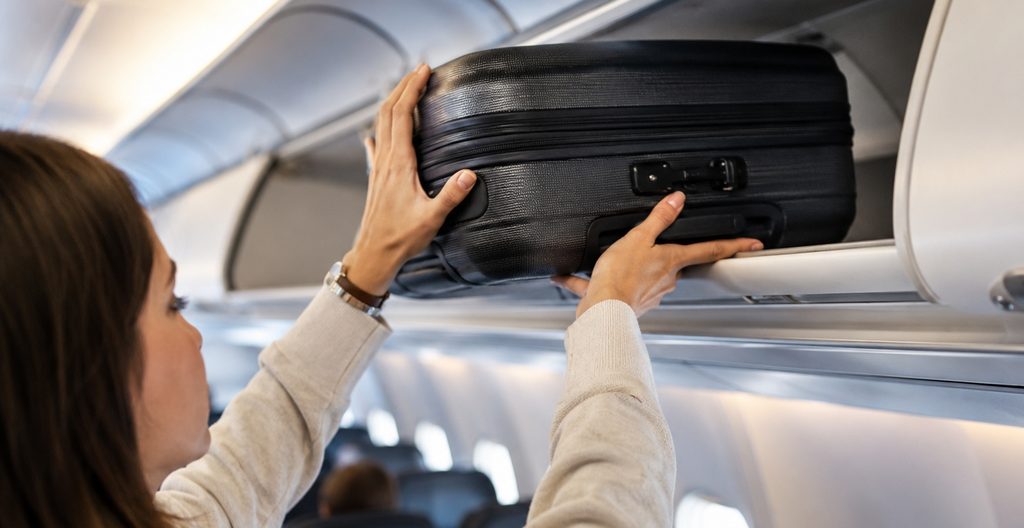
Pack your carry-on as if your checked bag will arrive a day late. That means:
- All documents and money
- All medication
- Phone, chargers, and adapter
- One full change of clothes
- Basic toiletries in travel sizes
- Glasses or contacts
- Anything valuable or irreplaceable
- House keys and anything you need the moment you land
If it would ruin the first 24 hours of your trip to lose it, it flies in the cabin with you.
The most commonly forgotten travel items
The things people forget aren’t obscure. They’re the opposite: they’re the items you use every single day, right up until the moment you leave, which is exactly why they never make it into the bag.
A survey of over 1,000 travelers by Radical Storage found that people forget an average of two essential items per trip, spend around $53 replacing them, and that the most commonly forgotten items are toothbrushes and toothpaste (22%) followed by chargers (19.1%). The same survey found 77.1% of people say a packing list makes them less likely to forget things, which is encouraging, because you’re reading one.
The high-risk list:
- Phone charger and wall plug (usually still in the socket)
- Toothbrush and toothpaste (used the morning you leave)
- Prescription medication (lives in the bathroom cabinet, not the suitcase)
- Sunscreen
- Travel adapter
- Sunglasses
- Belt (often on the jeans you’re not packing)
- Umbrella or rain layer
- Reusable water bottle
- The thing charging overnight: watch, earbuds, e-reader
The fix for the “used it this morning” category is simple: put a sticky note on the inside of your front door, or better, a shared last-minute list both of you can see (more on that below).
What NOT to pack
Overpacking is the forgetting problem’s smug twin. In that same Radical Storage survey, 71.7% of travelers admitted to overpacking, and 40% came home with clothes they never wore. Leave these behind:
- “Just in case” outfits. If you can’t name the day you’ll wear it, it stays home.
- A towel, unless you’re camping. Hotels and rentals have them.
- Full-size toiletries. Decant, or buy at the destination.
- A hairdryer, for most hotel stays.
- More than two pairs of shoes, unless a specific activity demands a third.
- Duplicates between partners. Two hairdryers, two full toiletry kits, two travel-size toothpastes per person. Shared items should be packed once (there’s a system for this two sections down).
- Anything cheap and heavy you can buy there. Beach toys or umbrellas are usually easier to pick up on arrival.
Packing by trip type: what actually changes
You don’t need six different checklists. You need the master list above, plus these adjustments.
| Trip type | What changes |
|---|---|
| Weekend trip (2 to 3 days) | Carry-on only. 3 outfits, 1 pair of shoes plus the ones you wear, travel-size everything. Skip the day bag; your carry-on doubles up. |
| One-week vacation | 5 to 6 mix-and-match outfits, laundry not required. Full toiletries. This is the sweet spot where a packing list pays for itself. |
| Beach vacation | Add: 2 swimsuits (one dries while you wear the other), cover-up, sandals, reef-safe sunscreen, waterproof pouch, after-sun. Subtract: most of the dressy clothes. |
| City break | Add: your most comfortable shoes, a secure day bag, offline maps. Subtract: bulky gear. Dress codes for restaurants or religious sites may need one smarter layer. |
| International travel | Add: passport and visa checks, adapter, local currency plan, copies of documents, vaccination requirements, roaming or eSIM setup. Double-check medication rules for your destination. |
| Road trip | Liquids rules don’t apply, so pack real-size toiletries. Add: car chargers, printed directions for dead zones, cooler and snacks, entertainment for long stretches, emergency kit for the car. |
| Family trip | Add: one packing cube or bag per child, double the snacks, entertainment per kid, any comfort item that cannot be left behind (the stuffed animal is a document-level priority). Build in twice the packing time. |
How far in advance should you start packing?
Start the list one week out, so items can be added as you think of them. Do the bulk of the physical packing two to three days before departure, when there’s still time to wash something or buy what’s missing. Leave only same-morning items for the last day, and keep those on a separate, visible list. Packing entirely on the final night is how chargers get left in walls.
Packing with your partner: the checklist most lists skip
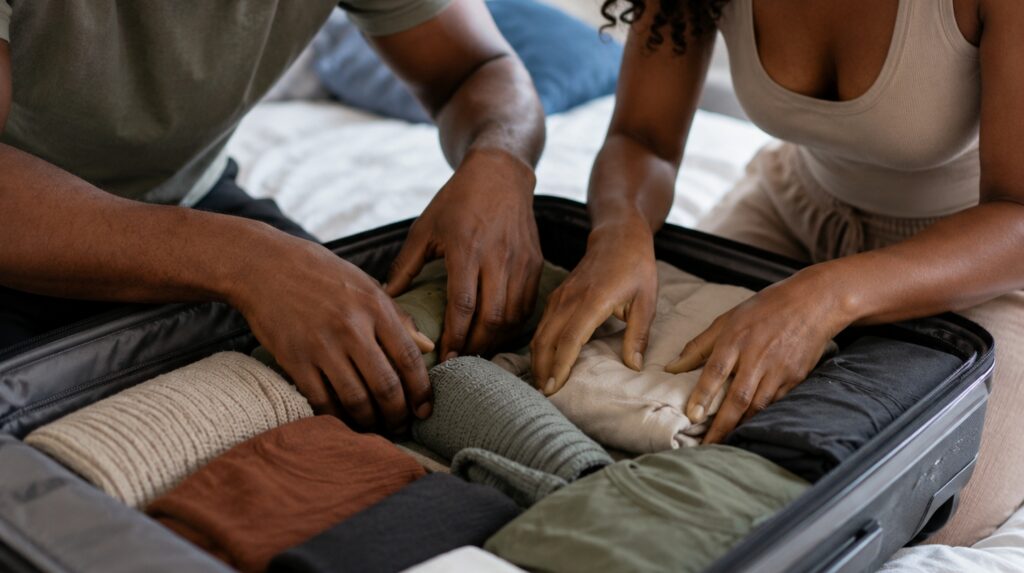
Here’s the thing about packing as a couple: the risky items aren’t yours or theirs. Your toothbrush has one owner and one bag. But the sunscreen, the adapter, the chargers, the snacks, the booking confirmations? Those belong to “us,” and us is not a person. Shared items get forgotten precisely because both of you can reasonably assume the other one has it covered.
The fix is a system we use for every trip. It’s four short lists instead of one long one:
Mine / Yours / Ours / Out the Door
1. Mine. Everything only you use. Your clothes, your toiletries, your meds. You own it, you pack it, nobody checks.
2. Yours. Same deal for your partner. No auditing each other’s underwear count. This is a coordination system, not a surveillance program.
3. Ours. Every shared item, and this is the rule that makes the whole system work: every item on the Ours list gets exactly one name next to it. Sunscreen: My partner. Adapter: Me. Chargers, first-aid kit, snacks, camera, beach towels, booking confirmations. If an item has no name, it isn’t packed; it’s just hoped for.
Two supporting rules for the Ours list:
- Whoever uses it last packs it. Chargers stay in the wall until the final morning, so they belong to whoever is up last the night before.
- One person owns documents. Passports, confirmations, insurance. Not because the other person is unreliable, but because “I thought you had them” at the check-in desk is a conversation nobody needs.
4. Out the Door. Not things you pack, things you do, in time order: check in online, charge everything, take out the rubbish, water the plants, book the taxi, lock up. This list is covered in full in the next section.
Ten minutes before you zip the bags, do a duplication check: read the Ours list out loud together. It catches the two hairdryers and the zero adapters at the same time.
This system works on paper or in a notes app. It works even better somewhere you can both see it update in real time using Cupla. A shared to-do list means “done” is done for both of you, labels split Mine from Yours from Ours, and reminders handle the last-morning items that memory reliably drops. In our 2025 Impact Report survey of 2,110 users, 71% said Cupla reduced their stress, and pre-trip week is precisely the kind of stress it was built for.
The before-you-leave checklist
Packing gets all the attention, but the travel-day disasters usually come from the trip prep nobody wrote down. Split it by time, not by category.
A few days before
- Check in online as soon as your airline allows
- Confirm bookings: accommodation, car rental, airport transfer
- Arrange pet, plant, and mail care
- Notify your bank if you’re traveling somewhere unusual for your cards
- Set up roaming or an eSIM
- Download offline maps, boarding passes, and entertainment
- Buy anything still missing from the packing list
The night before
- Charge every device, and set the chargers next to your bag, not in the wall
- Pack everything except tomorrow-morning toiletries
- Empty the fridge of anything that won’t survive the trip
- Take out the rubbish (Seriously. I forgot once. Just… please do it.)
- Set out travel-day clothes
- Agree the departure time out loud, including the buffer, so both of you are working from the same clock
Out the door
- Passports, wallets, phones, keys (pat-down check, every person)
- Chargers out of the walls
- Windows locked, appliances off, heating or air conditioning set
- Bins out if it’s collection day
- Water the plants one last time
- Lock up, and resist the urge to reopen the suitcase on the doorstep
Travel-day timing deserves one honest sentence: most airport stress is two people operating on two different mental schedules. Putting the departure time, the taxi booking, and the check-in deadline where you can both see them (a shared calendar does this well) turns “why aren’t you ready” into a question nobody has to ask.
Bookmark this before your next trip
A good packing list gets you to the airport with everything you own. A good system gets both of you there with everything you need, packed once, with no doorstep argument about who forgot the adapter.
If the Mine / Yours / Ours / Out the Door split sounds like something your relationship could use beyond the suitcase, that’s not a coincidence. Cupla is the planning app Erika and Will built for exactly this: shared lists, a shared calendar, and reminders that mean neither of you has to be the one who remembers everything. It’s free to download, and it travels well.
Get closer with Cupla.


FAQ: Travel Packing List
What should you pack for a trip?
Cover seven categories: documents and money, clothing, toiletries, medications, electronics, travel-day comfort items, and destination-specific extras. Pack your carry-on as if your checked bag arrives a day late: documents, meds, chargers, and one change of clothes always fly in the cabin with you.
What are the most commonly forgotten travel items?
The items you use right up until you leave: toothbrushes and toothpaste (forgotten by 22% of travelers), phone chargers (19%), prescription medication, and sunscreen. Travelers forget an average of two essentials per trip and spend around $53 replacing them: a packing list demonstrably helps.
How should couples split a packing list?
Use four lists: Mine, Yours, Ours, and Out the Door. The golden rule: every shared item (sunscreen, adapter, chargers) gets exactly one name next to it. If an item has no name, it isn’t packed. Then read the “Ours” list aloud before zipping up.